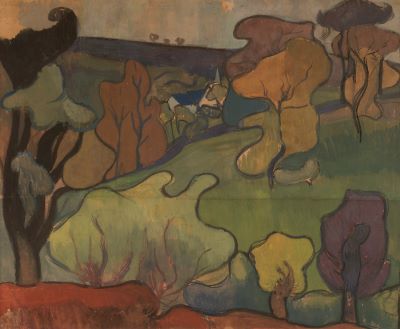

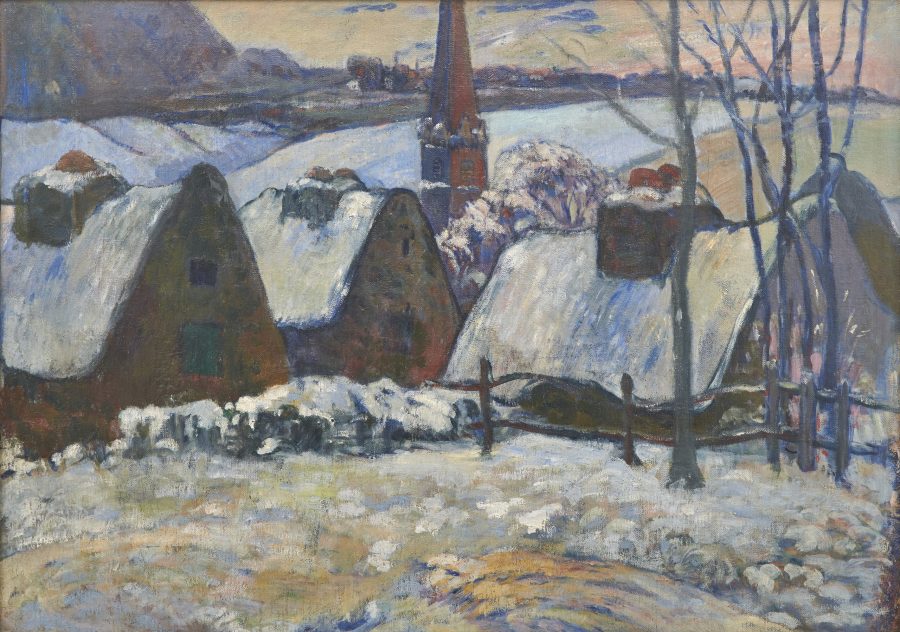
Paul GAUGUIN, Breton village under the snow
Let’s take 2 minutes to look at this painting by Gauguin. What do you think it represents? Perhaps Niagara Falls ? Or a village under the snow ? When Gauguin died in 1903 in Polynesia, his property was sold at auction in Papeete. The auctioneer presented this painting as Niagara Falls and everyone in the room laughed ! Because they found this artwork so terrible! The auctioneer had made a mistake and shown it upside down : it was not Niagara Falls but in fact the village of Pont-Aven under the snow. Fortunately, a famous Breton poet, Victor Segalen bought it… For only 7 francs ! It’s difficult to date this work precisely. Did Gauguin paint it in 1894 during his last trip to Brittany and took it with him to Polynesia ? Or did it paint it by memory, in the heat of Polynesia, as a sign of nostalgia ? In any case, this artwork was hung in his Polynesian home when he died. It’s not really typical of Gauguin’s work : no bright colours but soft ones. Nevertheless, if you focus on details, you may notice every shape has an outline, there is no perspective, it’s flat, and the tower of the recognizable church of Pont-Aven is deliberately truncated as in the style of Japanese art. And all these elements are recurrent in the art of the school of Pont-Aven.
To conclude, let’s take a closer look at the rustic wooden fence : you can find this motif in many artworks of Gauguin or Sérusier, representing a metaphoric border between reality and imagination.
Gauguin never painted outside, he didn’t represent reality but used his memories, his ideas, and his vision.
And you? What does this snowy landscape remind you of ?